PASIC 2015 Preview!!!!

I am very happy to officially announce that I will be conducting the Mallet Percussion Lab at PASIC 2015 in San Antonio, TX. The Lab will be presented at 1:00 pm in room 006 on Thursday November, 12th. I have been wanting to announce this for quite some time but I had to wait until all ducks were officially in a row and the date and time had been set.

If you are interested in participating please email Dan Ainspan at intern@pas.org to put your name on the list. Space is very limited but there is a wait list as it is quite common to have cancellations.

pasic15logomainpage

Rather than do a typical mallet lab where we listen to Porgy and Bess for the 23,426,899th time I thought it might be interesting to do something different. Plenty of time is spent discussing excerpts and honing our skills on xylophone, glock, and vibes as far as excerpts are concerned. But not a lot of time is spent on the solos we are asked to play in these audition environments. Yes, I know that tons of time is spent on marimba solos in our field, but not in the context of an audition. Specifically an orchestra audition or a summer festival audition. In these environments you don’t have the time to play the heavier repertoire that many prepare for recitals and college auditions. In an orchestra audition, the focus is on your orchestra playing. The solo is just a nice dessert. So how should it be treated and prepared differently? THAT is what we will discuss in the Mallet Lab this year at PASIC!
2015-09-05 15.12.25

If the committee wants you to choose your own solo then they want to get a good sense of your musical personality. Just the choice of a solo tells a lot about you. Is it aggressive? Is it soft and sweet? Is it ironic and humorous? This will help them get to know your solo voice. Since it is a solo of choice, they are not looking to compare you to others, so much as to get to know you.

So what sort of musical content should this solo have? Well the committee is leaving it up to you so they are obviously looking to be impressed with some personality and expression. Since you have the committee’s attention at this point I think it is important to grab it right away. A long, slow opening can take too long to develop in this situation. The committee is used to listening to excerpts that are over in 30 seconds. A solo that takes 60 to really get going will lose them before you really began.

Chops are important to have but I think are largely overrated in this scenario. If you have made it to the finals, they know you have chops, now they want to see if you have a voice. So the difficulty level doesn’t have to be a 10 out of 10. I think there are several advantages to playing a moderate solo as opposed to a difficult one. First, the chances of success are much higher with something you know you can pull off 99 times out of 100. Second, a truly difficult piece could be lost on the committee. There might be some that are really “wowed” but chances are a good portion won’t know what they are listening for and could be more perplexed by the difficult repertoire than impressed. Giving them something very approachable and easy to grasp, yet still impressive, is the balance you should try and strike. The last point I’d like to make about the difficulty level is one most don’t consider. Preparation. This is an orchestra job. Not a soloist job. If you spend 40% of your time working on a really difficult solo, then your excerpts (what really matter) will probably suffer. Pick a solo that you are comfortable with and won’t take too much time away from your excerpt preparation.

When a committee asks for a specified solo, they are still looking for all of the personality I discussed above, but they are also looking to more easily compare your playing to others. It is much easier to compare 5 candidates when they all play the same solo, than 5 different ones. If this is the case then you should still think about ways of showing your own personality but perhaps in a conservative way. You want to stand out in a good way. I have heard many players trying to do too much and end up standing out in a bad way. The committee is listening to the same solo over and over again so a lot of it is going to sound exactly the same. When they do hear something different you want the committee to say “Oh that was very clever, I like what they did there.” Rather than, “Well…. that was different.”

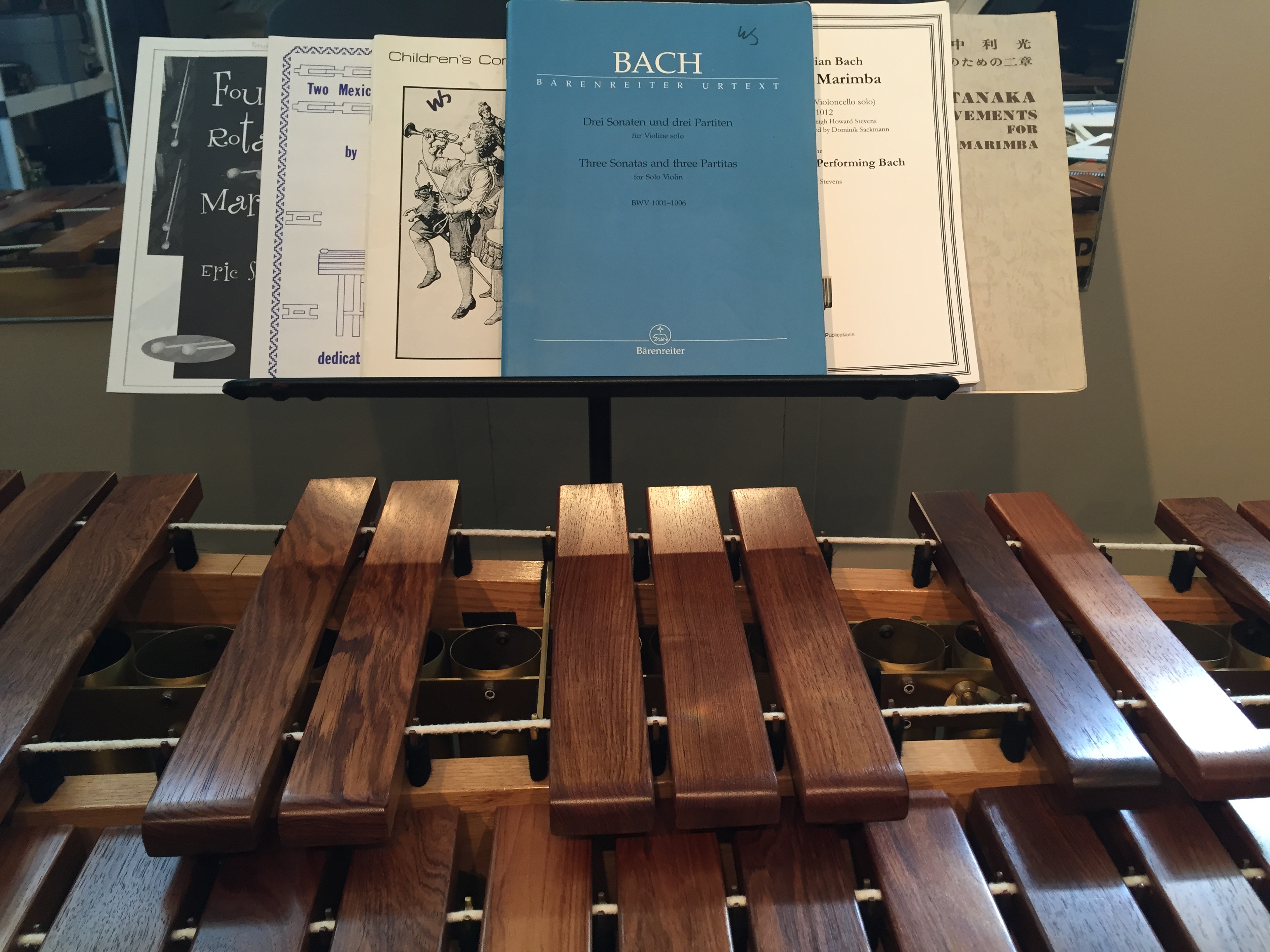
Bach is often asked on auditions as well. Sometimes as a Bach solo of choice but also as a specified Bach solo. Either way Bach is a great way to hear solo playing in a familiar style so all on the committee. However, anyone who has played Bach in front of a group of people knows that it is very difficult to please everyone with Bach. There is no shortage of opinions on how one should interpret Bach, especially when it is played on an instrument the work was not written for. With this in mind, I usually suggest a conservative interpretation of Bach. You do want to show expression and musicality for sure! But you also don’t want to run the risk of offending anyone. This is a great moment to remember that you are being judged mainly on your orchestral skills. The Bach solo probably will not win you the job, but could potentially lose you the job. A conservative approach is probably the safest bet.

The students playing in the Lab will all be asked to prepare the Minuet No. 1 from the E major Partita for Violin by Bach. This will let everyone prepare the same solo as well as a work by Bach. After they have performed the Minuet, they will also be asked to perform a solo of choice with the instruction that we are simulating the audition environment. This will give the students the opportunity to both choose a solo for this situation, as well as prepare and perform that solo.

Finally I would like your help. I would like to compile a list of good audition solos to distribute at the class at PASIC. It will also be available on my website. Because I have still not conquered the task of knowing every piece in the repertoire, I would like your suggestions for good audition solo pieces. They don’t necessarily have to be for marimba either, but you should consult the general guidelines below. Post a comment below with some of your suggestions and I look forward to seeing you at PASIC 2015!!!

Will James’ Solo Rep List and Guidelines for Auditions


WJ

Technique Improvement and Maintenance: My Warm Up Routines – Four Mallets

Four Mallets

The next installment of my Technique Improvement Series focuses on four mallet technique. My how the world has changed in the last 40 some odd years. While most players used four mallet techniques 40 years ago, the demands on that technique were not nearly what they are now. 99% of college applicants are playing four mallet solos at their college auditions now. And hard ones at that. The solo repertoire has exploded and the ensemble repertoire has followed. Almost all of the contemporary repertoire I see with the St Louis Symphony (with mallet parts) requires the use of four mallet technique. This is hardly a newsflash but I don’t think this relatively new demand always makes it into our normal practice routine. Sure there are marimba jocks who have more technique than you will ever need for most situations. Sure the vast majority of ensemble parts don’t require advanced technique. However, there is repertoire out there that requires advanced four mallet technique outside the solo world and the world is still turning and composers are continuing to ask more and more of us.

In 2011 Opera Theater St Louis premiered a reduction of John Adam’s opera The Death of Klinghoffer. The opera had been written years earlier but John wanted to do a reduction so companies with smaller pit sizes could play it. The original requires 3 synthesizer players and 1 MalletKat player. The reduction was for 1 synthesizer player and 1 MalletKat player. Guess where a lot of those lost synthesizer notes went? That’s right, into the MalletKat part; and as we all know, what can be done with 10 fingers can’t always be done with 4 mallets. If I didn’t have fairly advanced four mallet skills there is no way this opera could have been performed. It is easily in my top 3 hardest ensemble parts I have ever played. Thankfully they have changed the part significantly since I saw it, but it is far from easy. What is scary is this train is just getting started and we should get used to it. With this small soapbox moment out of the way, let’s look at some ways to improve and maintain our four mallet playing.

2015-03-03 10.39.11

We are lucky that in the late 70’s Leigh Howard Stevens wrote the book for four mallet technique in Method of Movement for Marimba. Yes it is for marimba (not vibes or xylophone) and yes it focuses on his Steven’s grip but the resources inside apply to any grip and any instrument. Another book I like that is written with a younger audience in mind is Simply Four by Gifford Howarth. This is a nice introduction for a beginner before digesting Method of Movement.

2015-03-03 10.31.12

I approach four mallets very similarly to how I have approached snare drum and two mallets thus far. In a very scientific way that breaks down the technical demands of the instrument. Leigh Stevens does this in Method of Movement and Rob Knopper talk about his approach in his blog post about technical short comings. Because holding four mallets requires the use of lots of very small muscles I do not start very fast. I warm up very slowly and allow those muscles to literally “wake up” before approaching anything technically demanding. With this in mind, the first thing I do when I walk up to the instrument is play “8 on a hand” but with double verticals. I will usually stay with a fifth but will walk my way up the instrument chromatically. This is obviously very boring but the point here is to literally warm up.

Next I will work on some single independent strokes in some variation similar to exercises 1-5 in Method of Movement. Again, this is to wake the muscles up, not necessary extend our ability. Then I will do some slow scales using only one mallet (first 1, then 2, etc…)

2015-03-03 11.00.14

After I have done this very basic warm up I move to double laterals. Double laterals are one of the most common technical demands on the instrument. To start I will do arpeggios with the sticking below, continuing through all 12 keys. Some of the transitions are slightly awkward but I am not playing this for speed, just to continue warming up. Then I will work on exercises similar to #478-485 out of Method of Movement. This helps me work on both the inside and outside double laterals. You can continue through this section for more advanced exercises but this is certainly enough for a warm up.

Blog-Arp

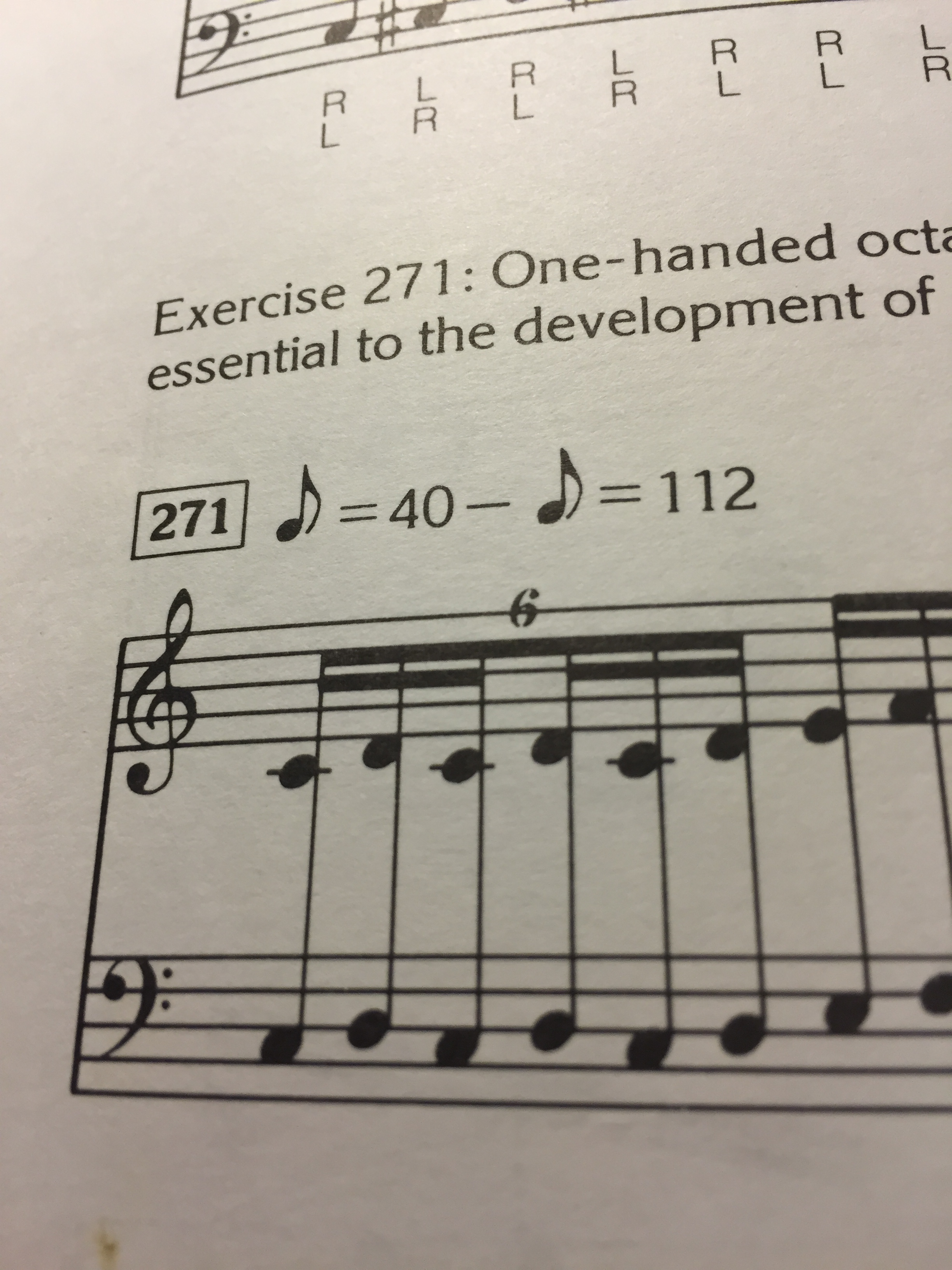
The next area I focus on is my octaves. Large intervals are difficult and I find some concentrated time initially really solidifies the proper finger positions. Exercise # 271 is my go to for developing control with octaves. Very simple but very useful.

2015-03-03 19.55.14

For a basic warm up this routine will get the fingers and hands warm. However, to continue to develop our technique we need to go a bit further. The next big task I tackle is interval changes. It’s great to be able to play fifths and octaves, but can you go from one position to the other? To play the modern repertoire you better be able to! The exercises on page 55 are great to begin to work on this. Interval changes are tricky so be sure to have a very slow tempo at first and start with the hands separate. I believe this is the hardest technical aspect of playing four mallets. Manipulating the mallets in this way is very tricky. Lots of time working on interval changes will pay off in the end!

Interval changes and shifting are somewhat related as they tend to both happen at the same time. If I find myself missing a note repeatedly in practice, most of the time it is because I am not shifting properly. Double verticals are a great way to practice this because it isolates the shift and doesn’t complicate it any more than it is. I start with the bottom of page 56 and work my way through the chapter.

Obviously I am a fan of the Method of Movement since most of my routine revolves around it. I do not spend a lot of time working on single independent strokes as the rest of my technical work takes care of most of that ability. Leigh does suggest some daily routines in the back of the book for additional focused technique work. In my experience, on marimba, vibes, snare drum or any other instrument this sort of technically focused work is great but can only take you so far. Applying it to the repertoire is where the next step is taken. Finding a passage that is technically demanding and slowly working through it is the ultimate means of improvement.

As always please leave comments below on your own routines or any questions you might have. Stay tuned for the next installment of this series focusing on cymbal playing!

WJ