This year at PASIC I finally met Rob Knopper. We have many mutual friends in common as well as both being at New World at different times so it was odd we had not crossed paths. It was great to get to know Rob and as we left I gave him a copy of my book and he gave me a copy of his recording of the douze etudes. I figured it was time to give them a listen. Here is what I thought…

#1
What immediately jumps out to me is the relaxed way Rob plays Delecluse. Our brains are spinning out of control trying to keep time and play these complicated rhythms but we don’t want it to sound that way. Rob doesn’t sound that way at all. The style and feel is very laid back and relaxed. The DVD helps as you can watch his body language as he plays. The tempo is slightly slower than printed (around 72) but as Delecluse himself says in Rob’s interview with him the details, and excitement are more important than the tempo. The only detail I play differently than Rob is I play the flams slightly more open. Rob and I both play the ruffs slightly closed but with an audible difference between 3 and 4 stroke ruffs.
#2
I have given this etude to a lot of students to learn as I think it is a nice intro to the douze etudes. The sudden dynamic changes are a challenge in this one and Rob handles them great. He is clearly playing #2 in the context of all 12 as the f and p are not extreme. Meaning the f is not extremely loud and the p is not as soft as he can play. In an audition I would probably advise expanding the dynamic range more if played as an isolated work. Rob’s ability to crescendo and decrescendo without it affecting his time are on display here big time and all of the grace notes are unbelievably crisp.
#3
# 3 starts to explore some more complicated rhythms and the players ability to subdivide is tested. Rob’s ability to keep the style and feel relaxed like in #1 is also impressive here. The details and time are important but the flow and style of the piece are what make the work “listenable”. Rob’s playing is very listenable… The rhythmic accuracy is also very impressive. I work out of Albright’s Polyrhythmic Studies for Snare Drum to work on this and after about half an hour I’m pretty sure my brain is mush. I like Rob’s solution for the flam on the ff roll 2/3rds of the way through. He is almost playing a 16th note to really show separation.
#4
The feel of this etude is a change from the first 3. This etude isn’t relaxed. It’s almost agitated. Rob does a good job of capturing this nervous energy in his playing. All of the dynamics are consistent with each other which really starts to become important as we go along in these 12. My only criticism so far is that a couple of the rests might be clipped a little in this etude which I don’t mind as much as this etude needs that front side of the beat feel. I particularly like the transition through the ritard and back into the a tempo. That timing is perfect.
#5
I’ll be honest this is probably the etude of the 12 I am least familiar with. It is very apparent though that rhythmic precision and smooth rolls are a must for this etude. Rob clearly has both. The p dynamic is within the context of all 12 etudes similar to #2 as well as the f. The rolls are particularly impressive in this etude as they are incredibly smooth and show great dynamic control. There are lots of opportunities to crescendo and diminuendo within these rolls and show nice dynamic shapes. Rob does this very well.
#6
I really love this etude. Very under performed in my opinion. Although this is still a French etude it is the closest to the Wilcoxon swing solos I grew up with. It is remarkable how rhythms can be played straight and yet feel like they swing. Something someone smarter than me should analyze. In #6 all of the grace notes need to be clear, consistent, and controlled. Rob has a great laid back feel in this one and has an enviable touch on the drum. All of the grace notes are remarkably consistent, especially the flams. Even the flams before the rolls are exactly the same as the rest of the etude.
#7
This etude seems rather innocent at first glance but as it goes on it becomes much more complex. The waltz feel is well set up early as the rhythms are not as complex and the listener can get a good sense of the tempo. Dynamics and quick dynamic changes start to complicate things until finally the rhythms get much more disjointed and intricate. Rob is very clear in navigating this treacherous water and keeps the pulse very steady throughout. Like previous etudes Rob’s pacing is excellent at the ritard and a tempo for a recap of the beginning material.
#8
Similar to #1 Rob chooses to take this etude slightly slower than written and I think this is very wise. The devil is in the details once again and even if played accurately it is very easy for those details to get lost. I love how Rob tackles the dotted eighth, sixteenth rhythms versus the triplets. There is a very clear difference between the two but not so over exaggerated that it loses its forward momentum. This would not be as enjoyable at a faster tempo. The ending stuck out to me on this one as being very well paced. The slow crescendo to the end was well timed to peak right on the last note.
#9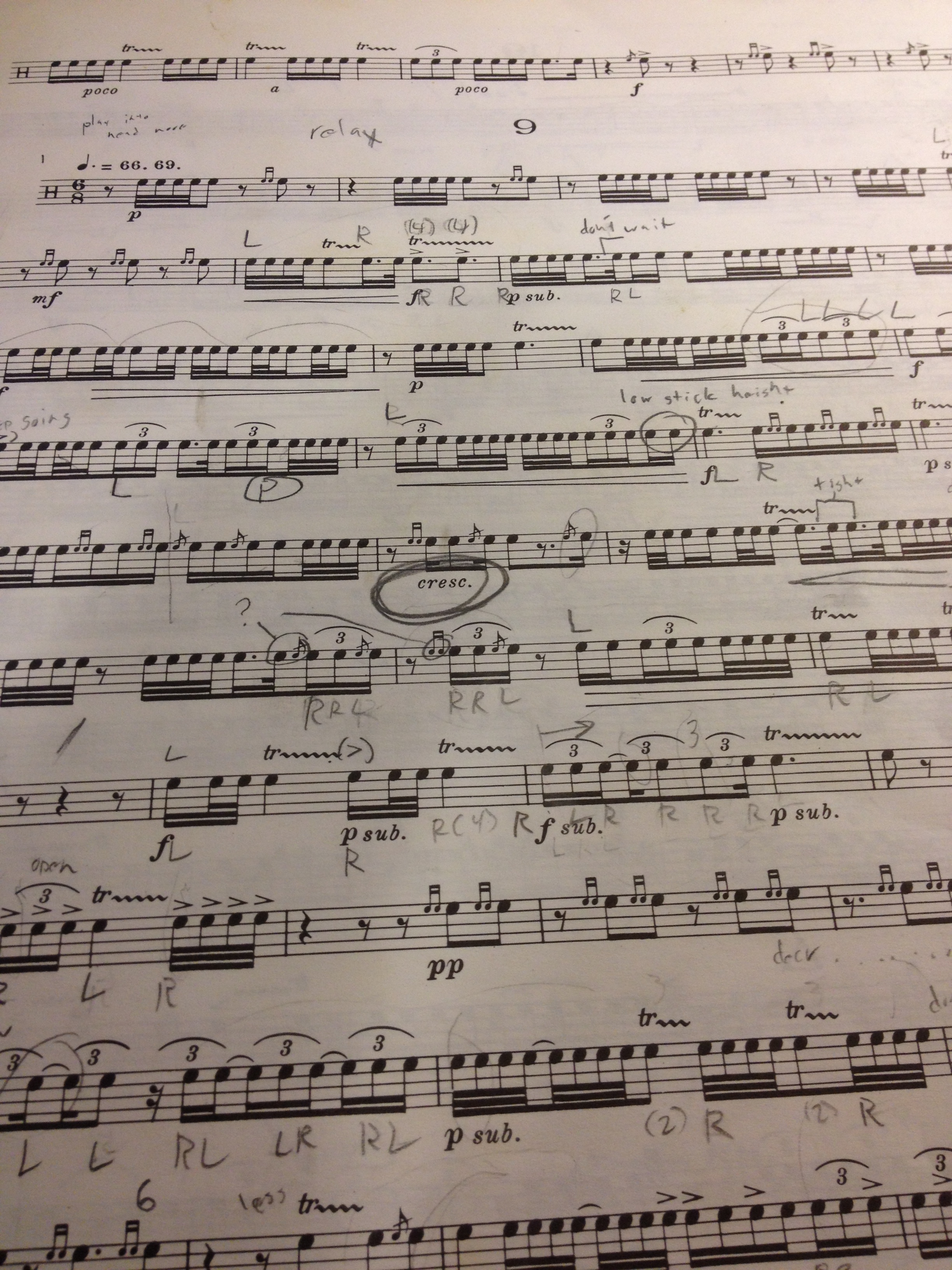
Anyone who has played an orchestral audition in the last 20-30 years knows this etude inside and out. as with #8 the devil is very much in the details. What I love about #9 is that it combines complexity with an elegant waltz. If the feel is tight and stiff it doesn’t work. However, if you play too loose then the details aren’t exact enough. A great balance to try and reach. Rob does a fantastic job of striking this balance. All of the details are there for those looking to hear exactly what those rhythms are supposed to sound like. Ironically what I like the most are the rests. Our brain is processing things so fast in this etude we tend to rush the rests and destroy the waltz feel. Rob maintains a steady, relaxed pulse throughout, striking a great balance between precision and style.
#10
For those of you curious, yes there are three more etudes after #9. I know for a while in my early twenties I was unaware of these last three. #10 is a great study in subdividing and dynamic control. I always had trouble saving the ff and pp until the end so I could show a different extreme. Rob does a great job of saving these extremes until the end while still giving sufficient contrast between the dynamic levels up until this point. Again, I have to point out that the pacing at the transition during the ritard is excellent. Something beginners should really take notice of.
#11
For some reason this etude reminds me of some of the Keiskleiriana etudes I have learned out of both book 1 and 2. This etude uses lots of the same rhythms but repeated in different ways and displaced over different beats. Subdividing is key to maintain a steady pulse as well as great dynamic control. I have had sympathy for the recording engineer for this project. Snare drum is one of the most difficult instruments to record and have dynamic range. Shout out to Brandon Johnson! This would be one etude I would really be interested to see Rob’s Starter Stickings as some of the quick dynamic changes require create solutions to pull off. Rob’s dynamic control is great and very consistent throughout.
#12
Rhythmically this etude is rather intimidating. It takes a while to get comfortable with the subdivisions and mixed meters before even coming close to playing at tempo. Rob does a nice job of balancing the details without sounding tense (similar to #9). #12 really brings all of the elements of the previous 11 into a nice conclusion. For me dynamic control, tempo, grace note consistency, rhythmically accuracy, and roll control are fundamentally what these etudes are meant to challenge. Rob does a tremendous job not only in #12, but throughout, of addressing all of these concerns and still sounding musical. On a snare drum no less!
This resource has been long awaited. I’m sure others have thought of recording these etudes, surely 1 and 9, but none have attempted. Rob Knopper gave all of us a resource for years to come in not only audio form but video. The video component is huge for young players to see how relaxed and efficient Rob is in his playing and movement. I’m glad I have my copy!
WJ



 William James