Technique Improvement and Maintenance: My Warm Up Routines – Triangle

Believe it or not, on occasion, I practice the triangle. Maybe I don’t need a 20 minute warm up routine for triangle, but there are definitely certain skills I want to stay sharp on. For this reason I am going to focus on a little bit more of the “how to” part of playing triangle in this post. I’ll also cover how I practice it as well. Triangle may be the joke instrument of the percussion section but the older I get, the happier I am to be playing triangle as it is one of the most portable instruments we play!

Holding the triangle
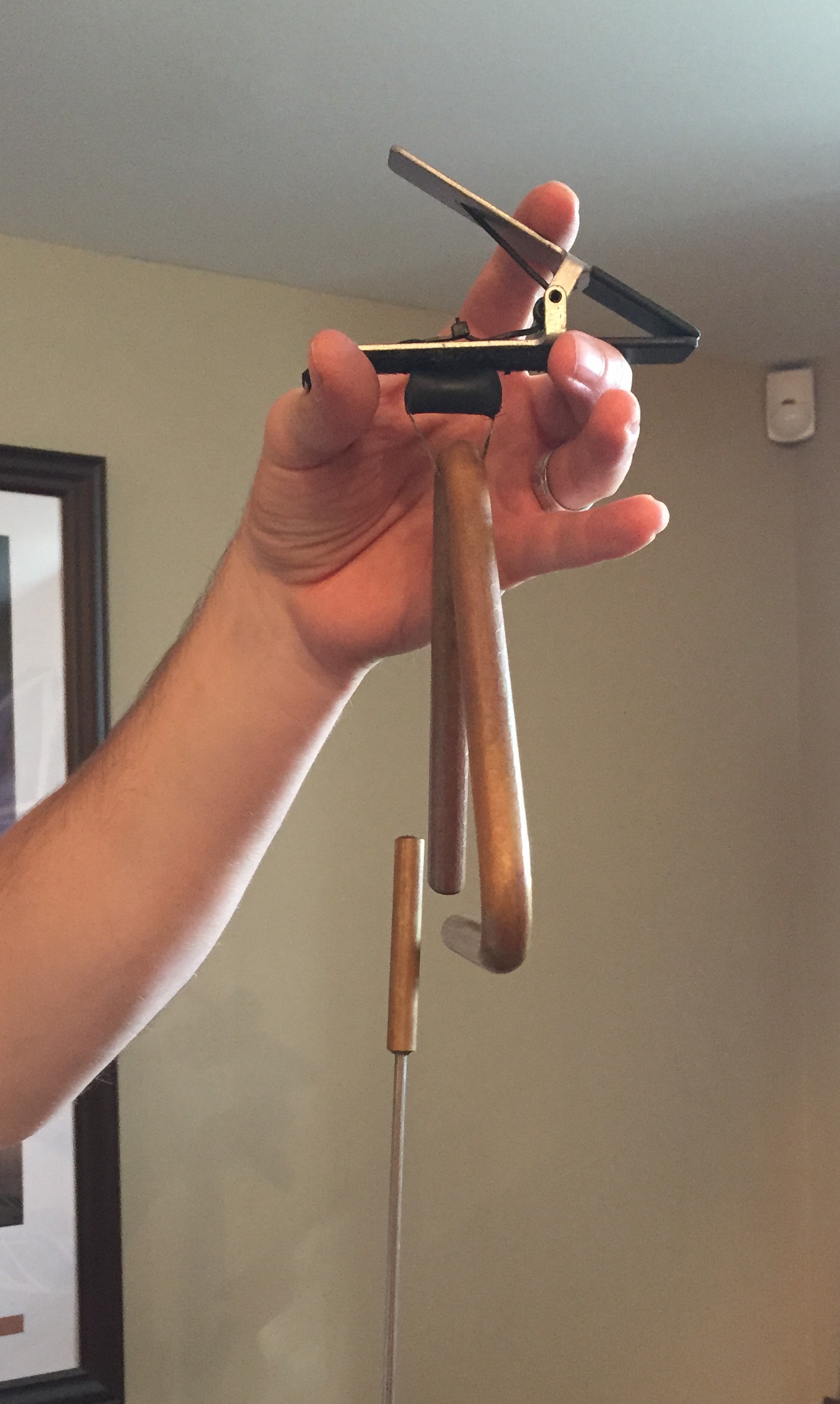
Holding the triangle should look graceful. We want to at least look professional. Resting the clip on the thumb and middle finger, leaves the other fingers available for muting if necessary. Holding the triangle around eye level is preferred so the audience can see what you are doing but also to allow the sound to travel without any interference from a music stand or any other instrument.

2015-04-12 16.57.06

Gripping the beater
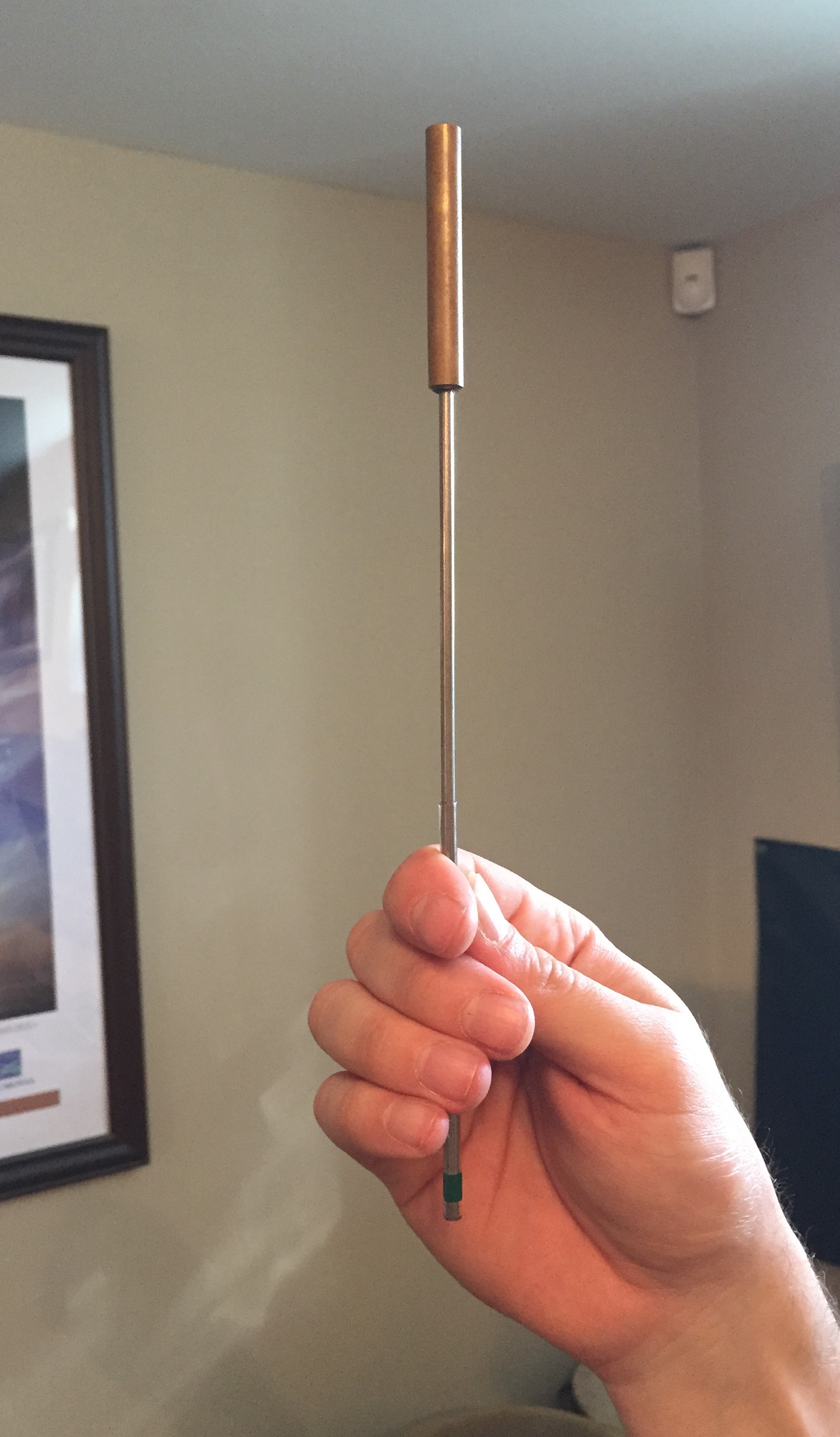
I have heard of two ways to hold the beater, although I’m sure there are many more. The first is similar to a snare drum or timpani grip. Very typical, with most of the pressure using the thumb and first two fingers. The other is almost like the inner mallet using Stevens grip; the mallet just slides into a different place in the palm. Chris Deviney showed me this grip. It is a nice alternative option to use when playing rolls or rhythms in the corner of the triangle.
2015-04-12 16.57.342015-04-12 16.57.51

Playing areas
There are a lot of different sounds you can get out of the same triangle. The angle and placement make a big difference. A straight on attack will give you a more pure tone with less overtones.
2015-04-12 16.58.22

Adding more angle of attack will activate the triangle to vibrate in more of a three dimensional way and cause the triangle to have more overtones.

2015-04-12 16.58.40

I’ll cover how to play rhythms below but the same ideas can be used in the corners of the triangle when rolling or playing rhythms.

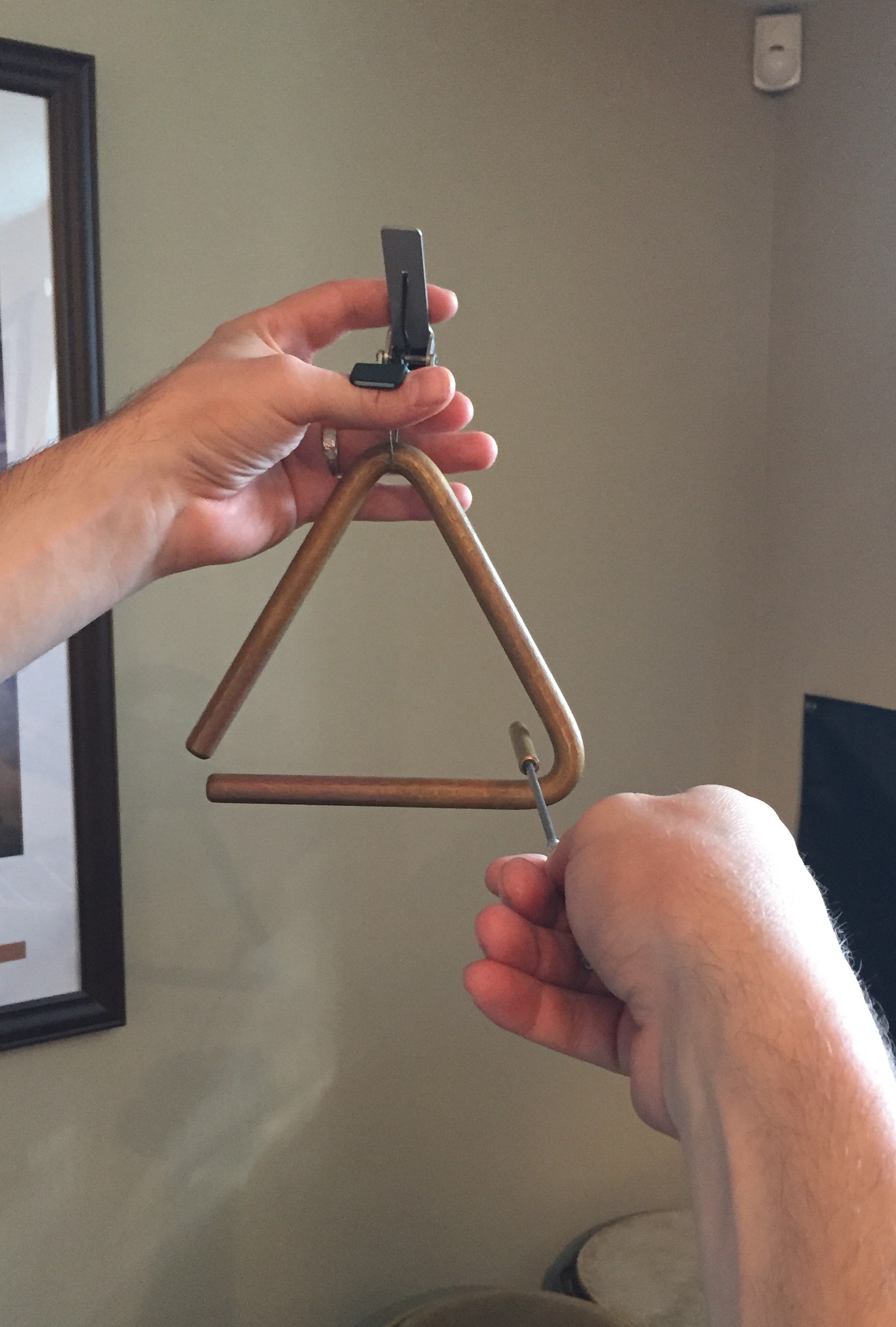
2015-04-12 16.59.422015-04-12 16.59.22

Now let’s get to actually playing the triangle and how to choose a triangle.

Almost all triangle playing for me breaks down into 3 categories.
1. Rhythms
2. Rolls
3. Single notes

Almost all triangles fall along two different spectrums
1. Clear tone —- overtone rich (shimmery)
2. Bright —- dark

Rhythms
Rhythms pose the most difficulties so let’s tackle them first. Generally when I am playing passages with anything remotely intricate I want a triangle with more of a pure tone that is clear so those rhythms will come out. If I use something with lots of overtones, the sound will be so broad and wide that the rhythms will just get lost. There is obviously a spectrum so you don’t have to immediately go to the clearest triangle you own, but this is a good philosophy to have. I generally let the musical context dictate whether I want a bright or a dark sound, but a bright sound will generally yield more clarity.

If lots of clarity of rhythm is needed a finger from the hand holding the triangle can mute part of the triangle. It doesn’t take much contact to really change the sound of the triangle so start conservative and add as needed.
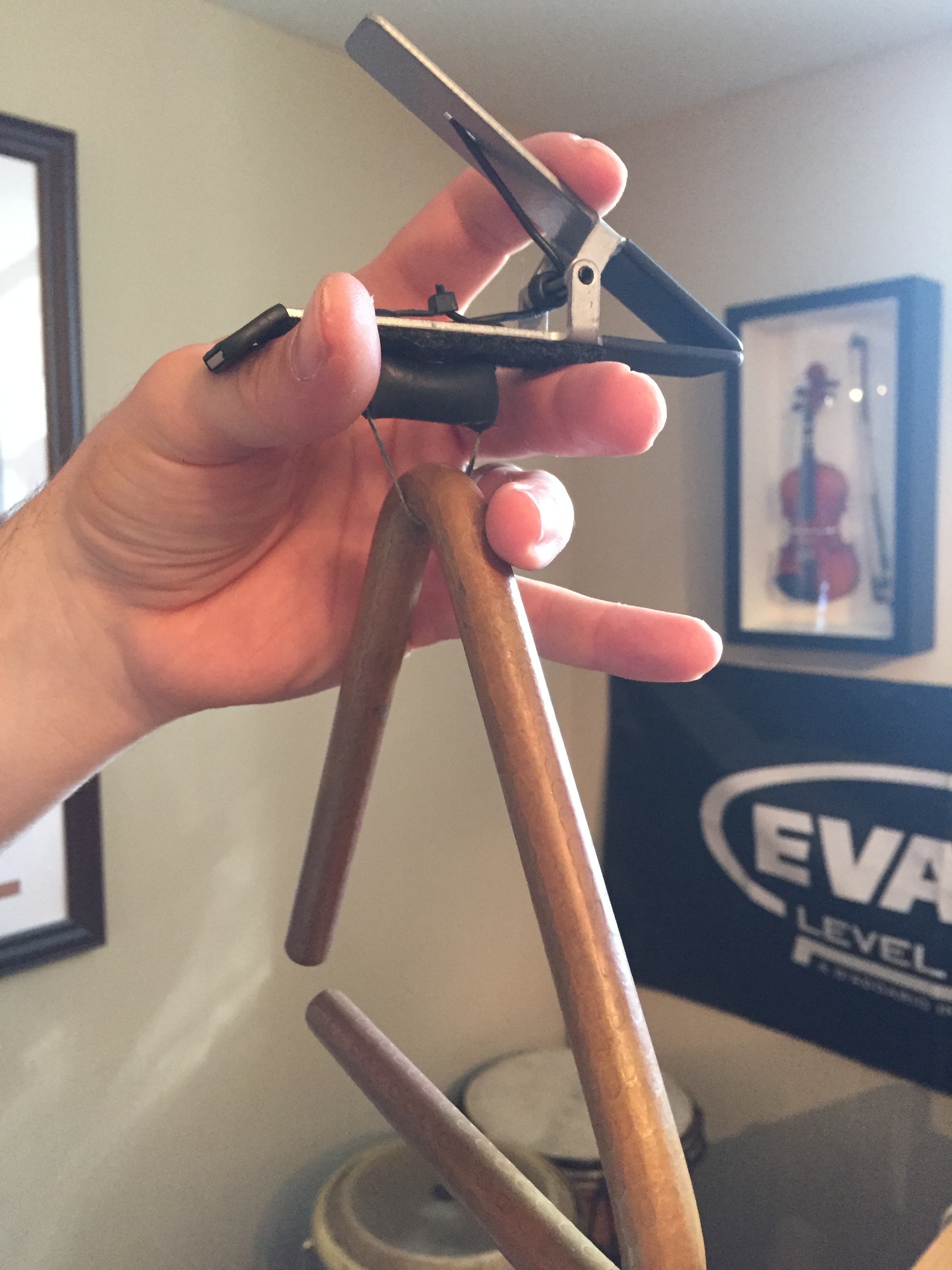
2015-04-12 17.00.42

If I can play the rhythms needed with single strokes, I will, as my consistency will inevitably be better. If the rhythms are too fast, I have a couple options for how to solve this. The first option is to play in the bottom corner of the triangle with an up and down motion. The “up” motion is generally weaker so a lot of times I will start with an up motion to make the rhythms sound more even. Playing in this corner of the triangle also allows the player to transition to single strokes much easier as the beater is in more or less the same place.

2015-04-12 16.59.46

Another option for playing rhythms is in the top corner of the triangle. This can be great for rhythms that need to be very clear. The angle of attack helps that. However, it is difficult to transition to single notes from this position and keep a consistent sound.
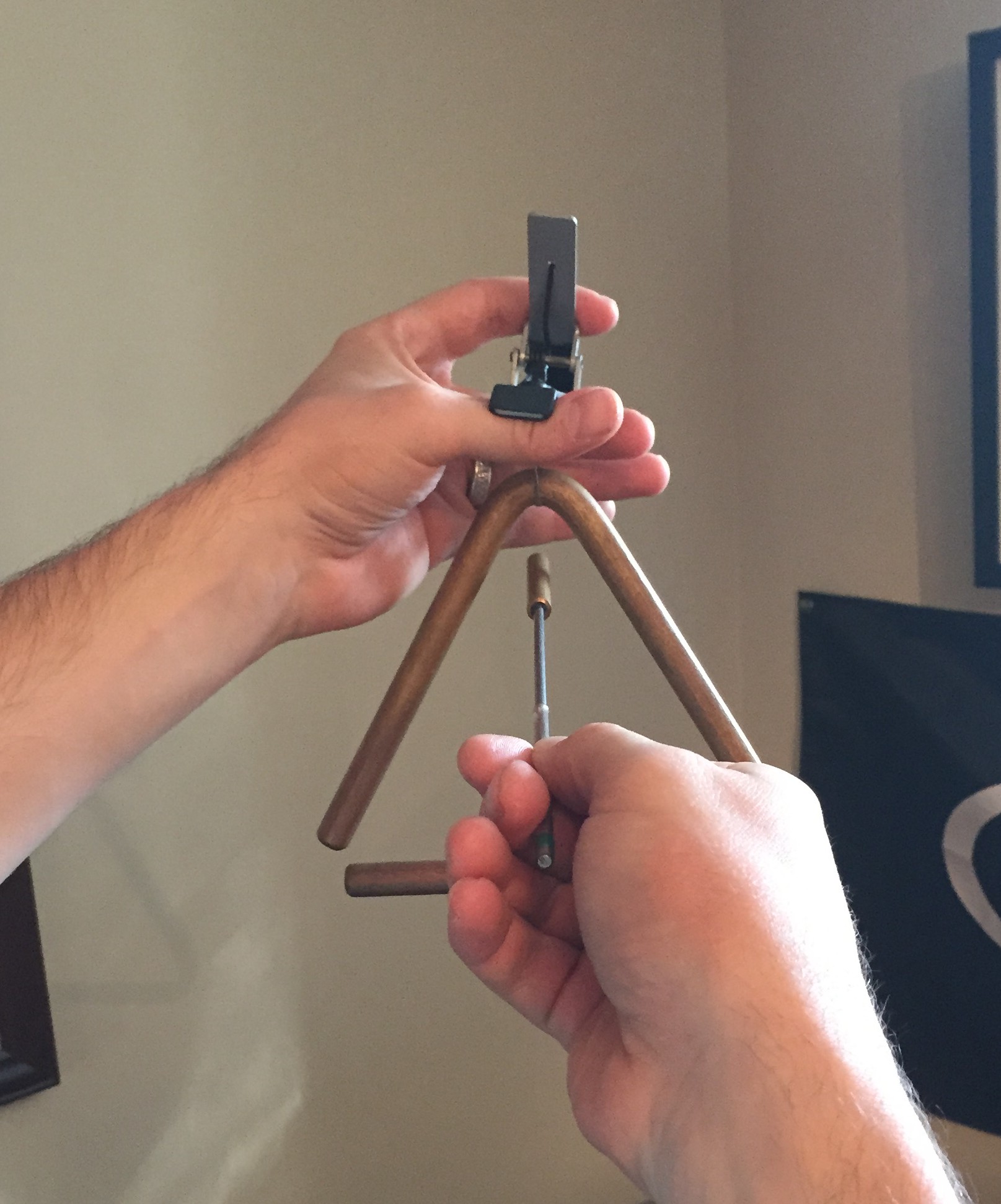
2015-04-12 17.01.19

Sometimes I will completely choke the triangle for practice. This makes the rhythms extremely clear. Once I’m happy with the evenness of my rhythms, I will let the triangle ring normally.

2015-04-12 17.02.11

The last option is to mount the triangle and play with two hands. This can be great for very intricate rhythms that need to be clear. It also makes execution tremendously easier! The downside is there is very little control of the ring in this position as both hands are occupied. When choosing this method it is important to mount the triangle using a very secure stand (usually a cymbal stand). Music stands are fine in a pinch but you will notice the triangle will make the entire music stand vibrate and take away from the triangle’s sound.

2015-04-12 17.04.54

Rolling
Triangle rolls are trickier to get a nice blended sound than one would think. We don’t want a dinner bell triangle sound 99.9% of the time. Playing in the bottom corner, with an angle that is consistent, is the best method. The alternate grip mentioned above helps this. This area is also great when needing to transition into single notes.

There are some additional techniques you might want to think about in certain situations. If the roll has a strong beginning, I like to put a burst at the start of the roll, giving it a nice accent. This leaves no confusion as to where the start of the roll is. If the roll needs to sound quasi-rhythmic then I will lessen the angle of attack on the triangle so I am getting less overtones.

Single notes
Some of the best parts in all the repertoire are single triangles notes. Just like a great soft cymbal crash, these notes can really capture a great moment. I am very picky about my triangle sound in these moments. It is here where we can really think about our full spectrum of sounds mentioned above. If I can use a really shimmery sound to capture a single note I will. If I need to play some slower rhythms then maybe I need to go with something a little more clear.

Just like with mallet playing, soft doesn’t always mean to use a small beater. A soft note played with a large, heavy beater can give the note more presence without necessarily more volume.

Another technique I will use when I can is vibrato. If you play a single note and then move the hand holding the triangle back and forth you will get a vibrato sound. This is definitely not for all situations, but can be a nice touch. I’ve had a few brass players turn around, notice it and smile a few times.

Triangles are a lot like cymbals in that each one is different. There is a lot of room for experimentation and thought. I generally practice the roll and controlling my rhythms. For that I use Keith Aleo’s book Complementary Percussion. It’s such a great resource for these accessory instruments. The rest I treat as a big sound experiment to see what options fit the work the best.

The final installment of this series is coming up. Tambourine. As always let me know if you have any questions and thanks so much for all the support!

WJ

Thanks to my lovely wife for reluctantly taking all of the photos in today’s blog…

Practice Goals – Hour Time vs. Calendar Time


I find in both my own practice as well as my students, that it is very easy to have unrealistic goals. We all want to build Rome in a day. Wouldn’t that be nice. We might be able to build a few houses in a day, but certainly not the whole city. For this reason, I separate practice goals into two categories for my students. Hour time and Calendar time. Skills that can be learned in hour time are short term goals. Skills that require weeks and months to perfect take calendar time.

clock
Hour time is much easier to manage because we deal with it every day. Reviewing the snare drum part to Prokofiev’s Fifth Symphony won’t take very long. Memorizing the last 20 bars of a solo is something you can accomplish today. Learning a small part for a brass ensemble gig would also fall under hour time. These are all tasks that can be started and completed in a few hours, maybe even one hour. If you are having difficulty completing these tasks in a relatively short period of time then we need to examine your efficiency in the practice room.

Calendar-Generic
Calendar time is the time needed to learn and perfect big goals. It is unrealistic to learn Velocities in a week. This takes calendar time. It is naive to think you can perfect your timpani roll in a few days. Again, it’s going to take a while. Calendar time is unique because it not only takes a lot of hours to learn those concepts, but it also takes space between those hours. This is why I call it calendar time.

I’m sure if I locked you in a room with food and water and said you have a week to learn the notes to Velocities, you might be able to get close. But the experience would be terrible and odds are your memorization would be shaky at best. Now take that same 80 or so hours you spent in one week and spread it over 6 weeks and I bet you will yield a much better result. This is because of two reasons. You were more efficient in those hours and there was more time in between for your mind to literally digest the notes. This is precisely why I look at these larger tasks being accomplished over calendar time rather than hour time.

It is easy to understand big picture vs. small picture but isn’t there some space in between? This is the challenge. Big picture goals, like learning a snare drum roll, takes lots of individual practice sessions in which progress is slowly compounded into a tangible result. To do this, we must break the giant task into small steps. If you are learning a solo, concentrate on small sections. If you are learning a skill, like the snare drum roll, concentrate on isolated elements. The kicker is, not to look at the forest when you are working on the trees. If I’m focusing on keeping my wrist stabilized and not bending during my roll, of course my roll is going to sound terrible. I’m concentrating on a very isolated part of the roll. I don’t have all of the elements put together yet. Once I have all the isolate elements perfected, then I can start to put them together and begin to look at the forest.

The best sports analogy I use for this is my golf swing. I get so frustrated on the golf course because I don’t have a Rory McIlroy swing. I know what I’m supposed to do, but it’s so hard to repeat. It’s totally unrealistic for me to think I’m going to perfect the golf swing in a week or so. Maybe even in a few months. I can isolate small parts of it though and concentrate on one at a time. That is way more realistic. I gotta say though, this music thing is really getting in the way of fixing my golf swing…

A large part of this concept is for our brains. We can only practice one thing at a time and we can only do so much in a day. But when we look into the future or look into the past it is easy to get frustrated when skills are not learned in the time frame we would like. Patience and understanding that certain things take calendar time are important to maintaining our sanity. In my own practice I have found much more success when I slow down and really take my time, trusting that the end result will come.

WJ

I know I’m late finishing up my Technique and Warm-up Series. Thanks for being patient. The travel and vacation has thrown me off but the last two installments will be up in the next two weeks.

The Unthinkable: 6 scenarios when you shouldn’t be practicing

On the first official day of my vacation week (the St. Louis Symphony is dark this week) I thought it was appropriate to tackle a rare subject in the music world. When NOT to practice. This is sometimes a harder concept than when TO practice. As musicians we are programmed to take every available minute of every day and practice. We have musician guilt for the time we spend away from our instrument not practicing. Deep down inside we know there are times we would be better off stepping away from the instrument but it is a tough thing to actually do. How do we know when it’s time to put the sticks down?

1. After a major performance or audition.

This is the most obvious. The emotional stress can wear on any player and assuming there isn’t something immediately coming up, it is wise to take a few days off. I’m often surprised at how great my hands feel the first practice session back when I take a week off after an audition. The time off is good from both a mental and physical perspective.

2. If you experience pain.

This may seem obvious but can be hard for some to recognize. There is a fine line between discomfort and pain. There are certainly times when practice is uncomfortable. Especially when trying to break down a barrier. Pain however, is NEVER progress. Learning to distinguish between the two is vital. When discomfort transitions into pain, it is time to stop.

There are a lot more less obvious times where it might be time to put the sticks down. Lots of them are very personal and vary from player to player, but basic guidelines can help.

3. When I am no longer practicing efficiently.

Most of my practice schedule and guidelines are governed by efficiency. I want to be as efficient as possible. Get in the practice room and get out. I want to make the most possible progress I can while I am in the room. I purposely do not have any chairs in my studio so that I am not tempted to sit down. I’d much rather sit down on my couch in the living room in front of a ball game.

4. When my brain’s “note learning capacity” is full.

If I am learning or memorizing music, I know I can’t go more than an hour. Learning music takes so much brain power and mental energy that I am no longer efficient after an hour. I’d rather practice three times a day for an hour than for three straight hours. I will get a lot more work done in that time. If I tried to keep going longer than an hour it would certainly not be efficient practice.

5. When practice feels a little too much like work.

Of course practicing will feel like work at times. Maybe a lot of the time. But there are definitely times when I feel like I’ve been beating my head against the wall for a long time with no progress. This usually happens because of one of two reasons. I’m either attacking the problem in the wrong way or my brain needs a break. Both reasons require the same solution. Stepping away. If my approach is correct then I just need time. If my approach needs to be changed, then I need to reevaluate my strategy. 

6. When it is time to taper before an audition of performance.

Of course you need to practice in the days leading up to one of these big events, just make sure it is the right kind of practice. You also should be taking care of your body and making sure you get enough rest at this point. An extra hour of sleep is going to help your performance WAY more than an extra hour of practice. At this point the goal is no longer about improving so much as putting yourself in a position to play well.

A quirky topic this week (I know) but I thought it would be fun, as we all need to be told to put the sticks down occasionally. If you think of more times to take a break, comment below. For now I’m going to watch a little basketball and stare at the ocean. 😀

WJ


12 Thoughts from the other side of the screen…

12 Random thoughts from the other side of the screen

2015-02-17 14.32.50

During a recent audition for the Saint Louis Symphony, I kept a separate note pad next to my chair and made some notes that I thought would be helpful for those taking auditions. They are a combination of do’s, don’ts and general thoughts from a committee perspective. I always found it helpful to evaluate my playing from the committee’s perspective, because after all, they are the one making the decision.


1. Be running next to the train before you attempt to jump on.

When starting an excerpt or solo, make sure your brain is already subdividing in the tempo you want. If your tempo takes a bar or two to settle in, it tells the panel you were not ready to start the excerpt and you are going to struggle with entrances in the orchestra.


  1. No one expects a note-perfect round. Really!

Notes are important, but the musician playing them is infinitely more important. The committee is picking a colleague, not a winner of a competition. They want someone willing to take risks and contribute to the rest of the ensemble. Mistakes happen for everyone.


  1. Fundamentals are more important than being note-perfect.

Along the same lines as #2, the committee can generally tell the difference between a fluke mistake and a mistake due to a fundamental problem with an applicant’s playing. Once the committee picks up on a fundamental problem, your chances are not good.


  1. Every sound that is made from the door opening until the “Thank you very much”, is being judged.

This may seem unfair but think about who leaves the better impression. The player who noodles a little on the instrument, takes a lot of time between excerpts, makes lots of noise taking things out of their bag or the player who walks in quietly, plays efficiently, takes their time but doesn’t rush, doesn’t need a tuning note, and methodically plays the list? Point made hopefully.


  1. Don’t let technique dictate the music.

Every musician in history has gotten this direction from a teacher but it bears repeating. All instruments have their technical challenges but those who make them sound easy are the pros and very quickly stand out from the rest.


  1. Play the music first and the notes second.

This point was jotted down when I kept hearing trumpet players play the opening of the Promenade from Pictures note perfect but with radically different articulations throughout the excerpt. A consistent articulation throughout is valued much higher than note-perfect.


  1. A good risk can stand out from the rest.

Think about the life of a committee. They have to sit in the same place for hours on end without being able to move and have to listen to the same thing over and over. When someone takes something a little bit different in a good way it can score some major points. The key is making sure the risk is a good one.


  1. Find a few excerpts on the list that you can be incredibly expressive on.

So much of an audition excerpt list is testing technical chops. Make sure you take advantage the ones that are all about expression. Use them as an opportunity to move the panel.


  1. Don’t freak out if the committee asks you to play something again and differently.

Again, think about this from the committee’s perspective. Why would they ask to hear something again if they didn’t like something about it? They may know qualities of the hall that you haven’t picked up on yet and are giving you direction to make it better. They may just be testing your flexibility. Almost 100% of the time being asked to play something again is a good thing.


  1. Ask to play something again if you KNOW you can nail it a second time.

You don’t have many of these cards to play, but it is a valuable one to use when you need it. We all screw up. Asking immediately to playing something again and nailing it shows the panel that you know it wasn’t right and the first time was a fluke. This can be impressive.


  1. Don’t play too carefully.

This can go unnoticed for an excerpt or two but it will catch up to you. Careful playing ultimately sounds boring and that isn’t a trait you want associated with your playing.


  1. Focus on the beginnings of solos and excerpts.

The panel’s focus will never be higher than at the beginning of your round. It’s just human nature. Making sure your solo or first excerpt gets off to a solid start is very important. Remember #1 and making sure you are running next to the train before jumping on.


2015-02-17 15.26.40

These points are by no means all inclusive but were some thoughts that jumped out at me. I include a picture of the chair I was literally camped out in because this is the visual I would use when auditioning. This is where the committee is living for a full day. I wanted to make their job easy when it came to picking me. There are lots of topics I could jump into such as the mental game of the audition and how to prepare, but these thoughts were strictly from a committee’s perspective. I thought they could be useful to those preparing. If you have any more thoughts please leave them below.

 WJ


Technique Improvement and Maintenance: My Warm Up Routines – Cymbals

Cymbals

Cymbals are one of my favorite instruments to play in the orchestra. They can define a huge climax or color a soft, delicate passage. The color palette is extremely wide and the opportunities for experimentation are just as many. We sit in the back of the orchestra for so long, waiting for a chance to play, that it is nice to be creative when given the chance. I also think that cymbals can be one of the most intimidating instruments to play; especially for younger students. Just like your soft snare drum roll, if you don’t spend dedicated time to practicing it, chances are it isn’t going to be very good. Scheduling regular practice time on cymbals in vital to having a good, consistent crash.

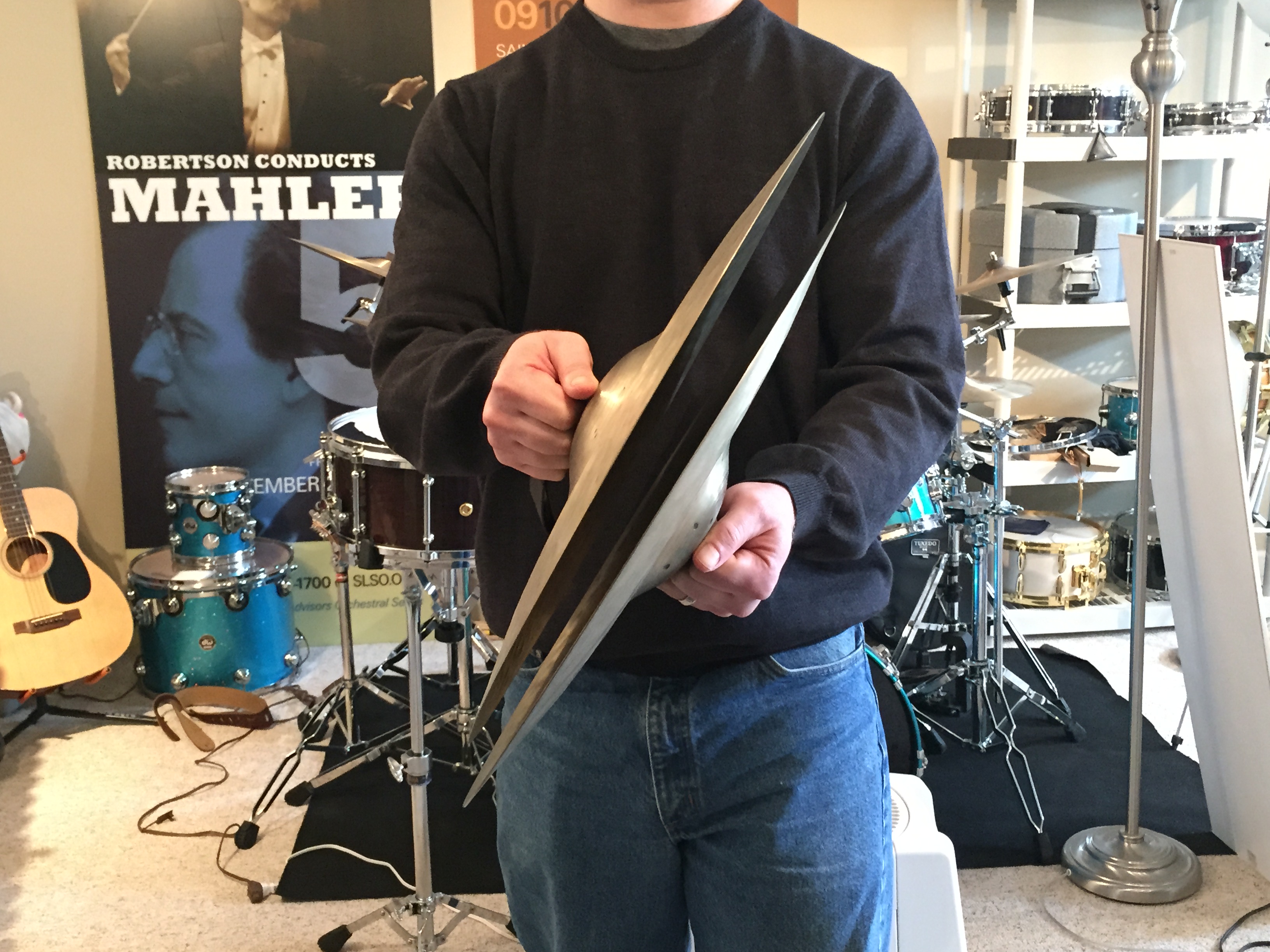
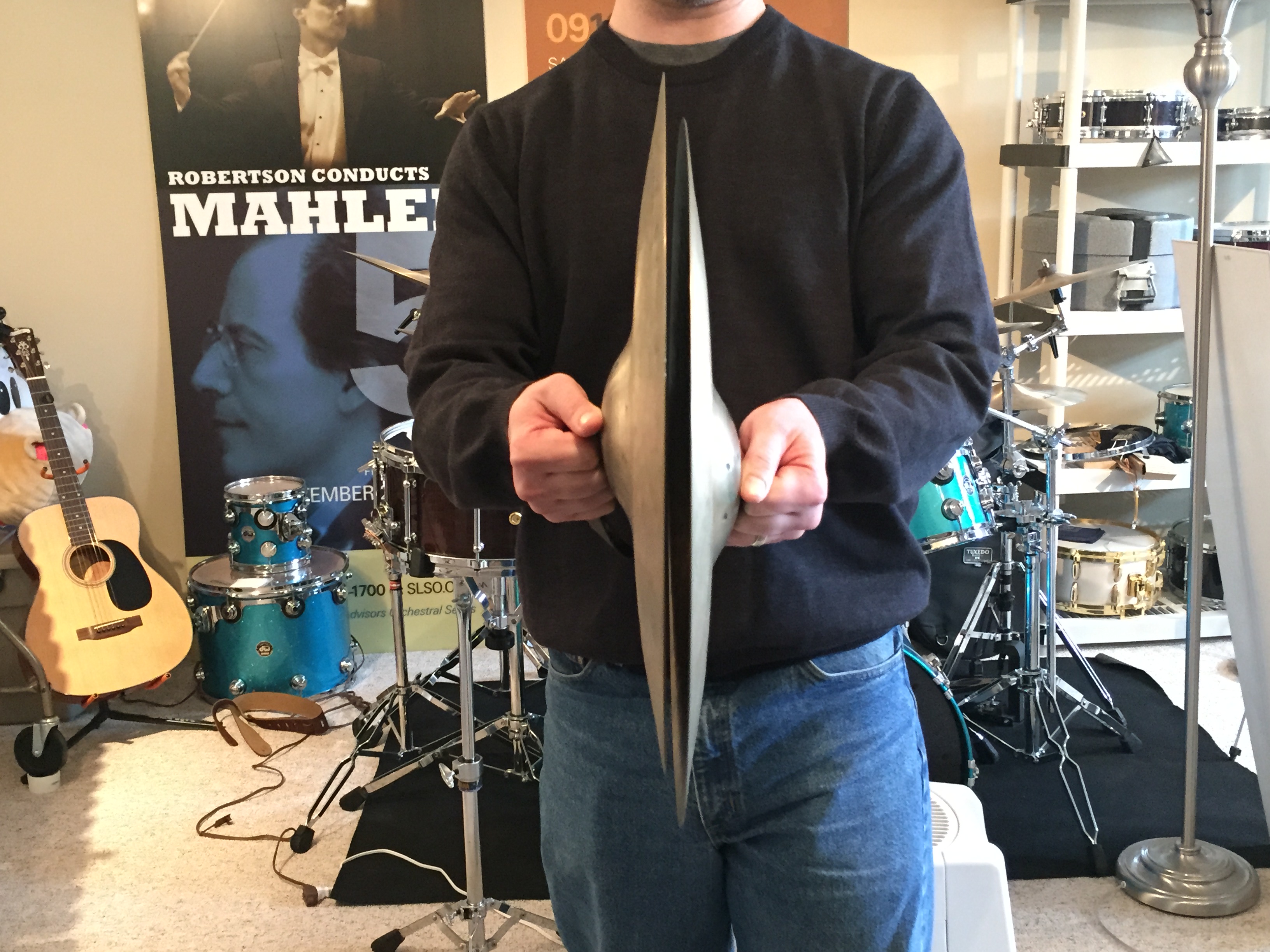
So how should we practice cymbals? Learning a good basic crash should be the first item on the to do list. This should cover the mf and above dynamic. The first thing we are all taught is that the cymbals need to come together with a flam. You can have the top hit first or the bottom hit first. Either way will work. This will prevent the air in-between the cymbals from ever being totally trapped and compressed, which causes an “air pocket”. All percussionists are more familiar with the air pocket than they would care to admit…

2015-03-14 14.13.242015-03-14 14.13.16

I also practice the cymbals coming together in super slow motion to find the best angle in which they like to come together. I’m not worried about the sound so much right now as I am finding a comfortable flam between the two cymbals.

Once we find a nice comfortable angle at which the cymbals can come together, the cymbals have to come apart. This is an often forgotten part of the crash and can lead to the dreaded air pocket. When choosing which end of the cymbal should hit first in my flam I prefer the bottom hitting first because the natural weight of the cymbals and gravity cause the cymbals to come back apart. The video below shows how gravity can help the cymbals come apart. When the top hits first (my personally feeling is) the hands and arms have to do more work to get the cymbals apart.

Now that we have a basic crash, we need to be able to repeat it. Consistency is a huge part of cymbal playing. You should be able to play 10 crashes in a row and they all sound the same. Not an easy task! So this is how I start my practice routine. I play a series of crashes at no particular tempo with the goal of them all sounding the same. My focus is on sound and my hands executing the same motion every time for a consistent crash.

2015-03-14 12.16.49

Keith Aleo‘s book Complementary Percussion, is a fantastic resource for exercises and etudes to work on all complementary instruments. Once I have consistent crashes I work through his exercises on page 33 & 34 to start controlling the cymbals with a specific tempo on the metronome. I do all of this at a mf or louder dynamic.

Just like with snare drum, I spend specific time practicing soft. The soft crash is slightly different than a mf crash or louder because all of the movements are minimized. The crash still needs a flam but the angle is smaller, the softer you get. I also slowly shift where the cymbals are in my preparation so that the cymbals are more vertical the softer I get. I find that at the soft dynamic, my eyes need to be more involved in checking the angle of attack. At the louder dynamic I can do this by feel, but at the softer dynamic, I need my eyes to do it. The pictures below show the progression of how I prepare from mf to ppp.

2015-03-14 14.13.432015-03-14 14.13.502015-03-14 14.13.562015-03-14 14.14.01

To get used to this concept I will play Keith’s exercise A but with a long crescendo and then a long diminuendo.

So we can play a crash, but now we need to stop it… Muffling the cymbals is just as important as the crash itself. A lot of times the composer doesn’t give us a lot of information on how long the note should be. So we have to make that decision ourselves. We also have to determine if the end of the note is quick or if we want to slowly damp the cymbals so the end of the note is less apparent. All of these options should be practiced so they are comfortable when in a performance situation. From a purely technical standpoint, I muffle the cymbals with my stomach. This keeps these large metal objects away from my ribs so I won’t have to worry about injury.

To round out the rest of my crash cymbal practice session, I will work on one of Keith’s etudes a day. Once I get to 10, I’ll go back to 1.

There are some extended techniques that can work great in specific circumstances. Occasionally I will leave the cymbals together a little bit longer than necessary on a soft crash and let them sizzle. This happens right as they come apart. I will leave the top edges still touching and lets the cymbals vibrate against one another for a nice effect. I will also occasionally scrape one cymbals against the other for a long note. This can also be done on suspended cymbal but the effect of two cymbals is different and can be very nice in the right situation.

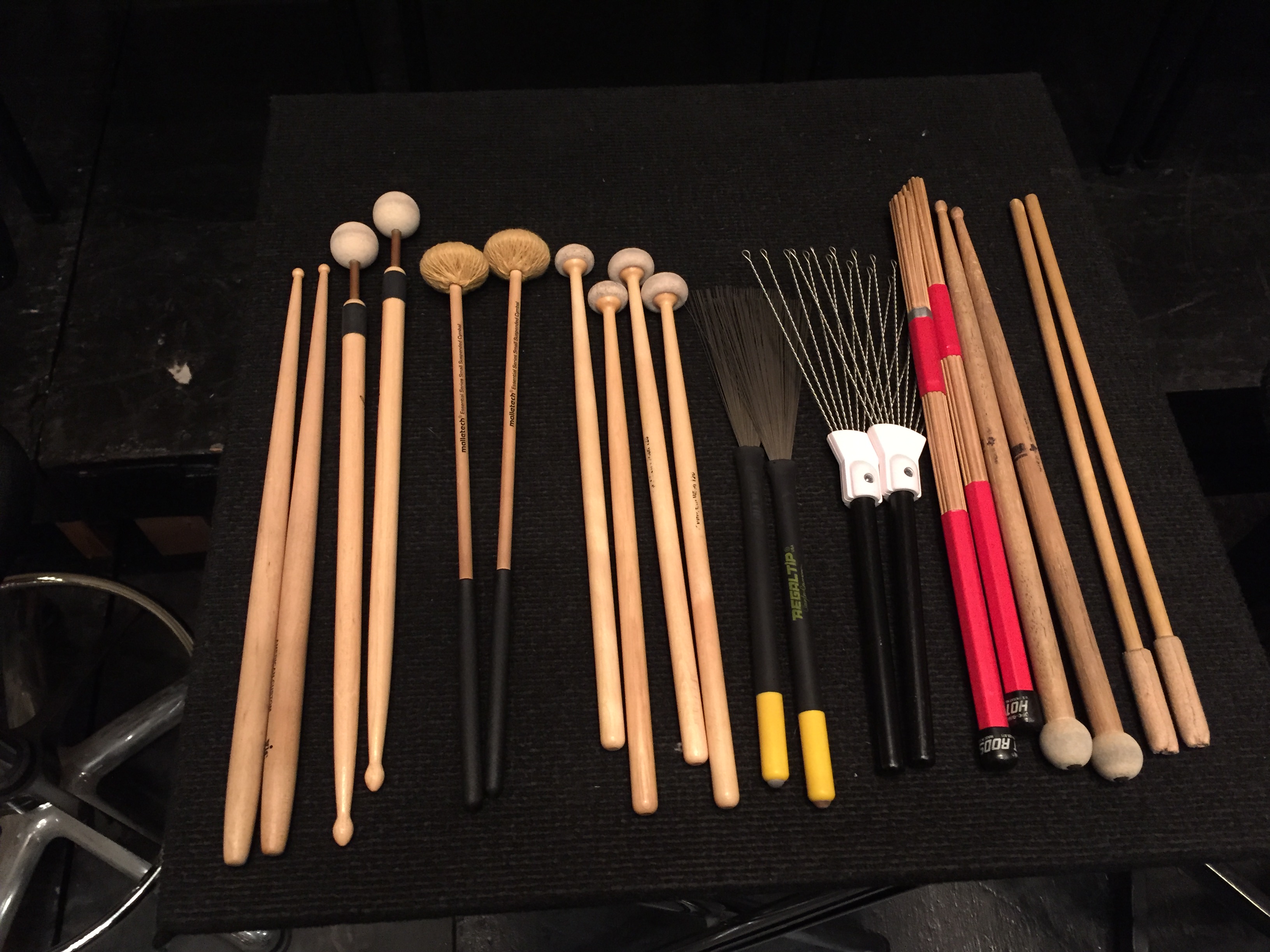
Crash cymbals are only one part of the demands on the cymbal player. Suspended cymbal playing is a huge part of the symphonic repertoire. Granted it isn’t the most technically demanding aspect of percussion playing but it might be one of the most creative! Just like mallet, bass drum, or timpani playing; I have a lot of sticks that create different sounds on the cymbals. Think of these sticks like different articulation options for the cymbals. You can scrape the cymbals with a file to create a long sound. You can strike it with a stick for a quick sound. You can tap it with a triangle beater for a ping sound. You can softly strike it with a soft mallet for a warm sound. Experiment with different options so your spectrum of available colors if wider. The picture below is of all my suspended cymbal sticks. I also use a variety of triangle beaters for scrapes and such but they wouldn’t fit on the table!

2015-03-14 19.43.20

There are some great resources out there for continuing to work on your cymbals playing. Zildjian has a great online Education Guidebook that is perfect for beginning players and teachers. They also have some great resources for how to pick out your first pair of cymbals. The Art of Bass Drum and Cymbals Playing by Tony Cirone and Garwood Whaley is another great resource.

Thanks for reading and stay tuned for the next post about more accessories featuring triangle and tambourine. As always leave comments below if you have something unique that you like to practice on cymbals.

WJ


Technique Improvement and Maintenance: My Warm Up Routines – Four Mallets

Four Mallets

The next installment of my Technique Improvement Series focuses on four mallet technique. My how the world has changed in the last 40 some odd years. While most players used four mallet techniques 40 years ago, the demands on that technique were not nearly what they are now. 99% of college applicants are playing four mallet solos at their college auditions now. And hard ones at that. The solo repertoire has exploded and the ensemble repertoire has followed. Almost all of the contemporary repertoire I see with the St Louis Symphony (with mallet parts) requires the use of four mallet technique. This is hardly a newsflash but I don’t think this relatively new demand always makes it into our normal practice routine. Sure there are marimba jocks who have more technique than you will ever need for most situations. Sure the vast majority of ensemble parts don’t require advanced technique. However, there is repertoire out there that requires advanced four mallet technique outside the solo world and the world is still turning and composers are continuing to ask more and more of us.

In 2011 Opera Theater St Louis premiered a reduction of John Adam’s opera The Death of Klinghoffer. The opera had been written years earlier but John wanted to do a reduction so companies with smaller pit sizes could play it. The original requires 3 synthesizer players and 1 MalletKat player. The reduction was for 1 synthesizer player and 1 MalletKat player. Guess where a lot of those lost synthesizer notes went? That’s right, into the MalletKat part; and as we all know, what can be done with 10 fingers can’t always be done with 4 mallets. If I didn’t have fairly advanced four mallet skills there is no way this opera could have been performed. It is easily in my top 3 hardest ensemble parts I have ever played. Thankfully they have changed the part significantly since I saw it, but it is far from easy. What is scary is this train is just getting started and we should get used to it. With this small soapbox moment out of the way, let’s look at some ways to improve and maintain our four mallet playing.

2015-03-03 10.39.11

We are lucky that in the late 70’s Leigh Howard Stevens wrote the book for four mallet technique in Method of Movement for Marimba. Yes it is for marimba (not vibes or xylophone) and yes it focuses on his Steven’s grip but the resources inside apply to any grip and any instrument. Another book I like that is written with a younger audience in mind is Simply Four by Gifford Howarth. This is a nice introduction for a beginner before digesting Method of Movement.

2015-03-03 10.31.12

I approach four mallets very similarly to how I have approached snare drum and two mallets thus far. In a very scientific way that breaks down the technical demands of the instrument. Leigh Stevens does this in Method of Movement and Rob Knopper talk about his approach in his blog post about technical short comings. Because holding four mallets requires the use of lots of very small muscles I do not start very fast. I warm up very slowly and allow those muscles to literally “wake up” before approaching anything technically demanding. With this in mind, the first thing I do when I walk up to the instrument is play “8 on a hand” but with double verticals. I will usually stay with a fifth but will walk my way up the instrument chromatically. This is obviously very boring but the point here is to literally warm up.

Next I will work on some single independent strokes in some variation similar to exercises 1-5 in Method of Movement. Again, this is to wake the muscles up, not necessary extend our ability. Then I will do some slow scales using only one mallet (first 1, then 2, etc…)

2015-03-03 11.00.14

After I have done this very basic warm up I move to double laterals. Double laterals are one of the most common technical demands on the instrument. To start I will do arpeggios with the sticking below, continuing through all 12 keys. Some of the transitions are slightly awkward but I am not playing this for speed, just to continue warming up. Then I will work on exercises similar to #478-485 out of Method of Movement. This helps me work on both the inside and outside double laterals. You can continue through this section for more advanced exercises but this is certainly enough for a warm up.

Blog-Arp

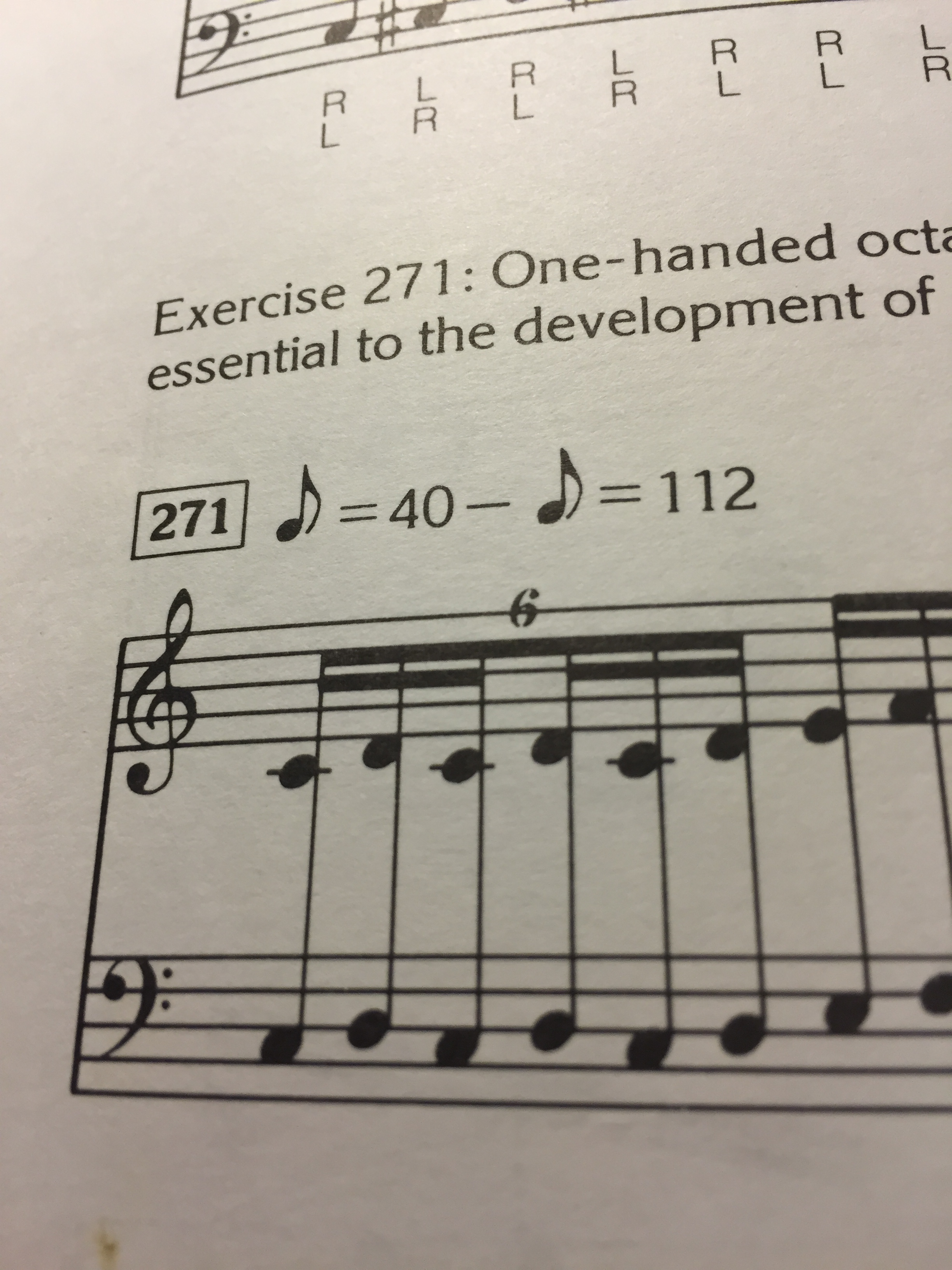
The next area I focus on is my octaves. Large intervals are difficult and I find some concentrated time initially really solidifies the proper finger positions. Exercise # 271 is my go to for developing control with octaves. Very simple but very useful.

2015-03-03 19.55.14

For a basic warm up this routine will get the fingers and hands warm. However, to continue to develop our technique we need to go a bit further. The next big task I tackle is interval changes. It’s great to be able to play fifths and octaves, but can you go from one position to the other? To play the modern repertoire you better be able to! The exercises on page 55 are great to begin to work on this. Interval changes are tricky so be sure to have a very slow tempo at first and start with the hands separate. I believe this is the hardest technical aspect of playing four mallets. Manipulating the mallets in this way is very tricky. Lots of time working on interval changes will pay off in the end!

Interval changes and shifting are somewhat related as they tend to both happen at the same time. If I find myself missing a note repeatedly in practice, most of the time it is because I am not shifting properly. Double verticals are a great way to practice this because it isolates the shift and doesn’t complicate it any more than it is. I start with the bottom of page 56 and work my way through the chapter.

Obviously I am a fan of the Method of Movement since most of my routine revolves around it. I do not spend a lot of time working on single independent strokes as the rest of my technical work takes care of most of that ability. Leigh does suggest some daily routines in the back of the book for additional focused technique work. In my experience, on marimba, vibes, snare drum or any other instrument this sort of technically focused work is great but can only take you so far. Applying it to the repertoire is where the next step is taken. Finding a passage that is technically demanding and slowly working through it is the ultimate means of improvement.

As always please leave comments below on your own routines or any questions you might have. Stay tuned for the next installment of this series focusing on cymbal playing!

WJ

Learning the Snare Drum Roll in 3 Minutes

I am taking a week break from my Technique Improvement Series to debut this new video. Next week it will return with tips for four mallet playing.

I have received many questions from percussionists about their roll and I have tried to answer a lot of them. I hope to answer more in this blog post but also in this new video.

I have received questions from students having trouble seeing learning the roll as a process. When you look at an individual chapter in my book it can be tough to understand how it fits into the entire process. You may have noticed I have used the word process a lot. That’s because that’s exactly what learning the roll is. A process. My hope with the video it to give you a very quick, overarching look at how you can build your roll from start to finish. Each step can take a while, and it should. Learning a new technique takes time to train your body. My hope with the book is to understand WHY you are doing something. It is so much easier to trust a process if you understand WHY you are doing something instead of “just because”. This new video is a nice summary of the first third of the book and how to slowly build your new technique into a roll you can start perfecting.

The biggest difference between my method of instruction of some of those historically taught is that my method teaches the roll as a NEW technique. Rather than start with a single stroke technique and change it and modify it until we arrive at a roll, I start with the roll as a completely separate entity. This can be frustrating a first because trying anything for the first time can be daunting. However, I have found time and time again, that ultimately this is a quicker path to success. Disclaimer: it may actually take longer than 3 minutes…

If you have more questions, be sure to leave them in the comment section and I will get back to you. Good luck!

Technique Improvement and Maintenance: My Warm Up Routines – Two Mallets

Two Mallets

In the second installment of this series I am going to tackle and explain my two mallet keyboard routine. This applies for all mallet instruments including marimba, xylophone, glockenspiel, and vibes. I chose to spend most of my time on xylophone when focusing on technique and improvement. The skills and technique used on xylophone transfers to all of the other instruments much easier in my opinion than the other way around.

There are several reasons for this tactic. The first is the instrument’s sustain. A xylophone has virtually no note length so it is much tougher to be musical. It is also easier to hear unevenness in your rhythm. All of your flaws are more apparent, which in theory, makes them easier to notice and then correct. If your flaws are corrected on xylophone then they really will be great on the more sustaining instruments. Another reason is bar size. I have found it is easier to go from a smaller bar size instrument to a bigger bar size than the other way around. Most xylophone bars are smaller than marimba and vibe bars. The last reason I start on xylophone is rebound. That may seem confusing since the xylophone has no rebound. Even though all of the mallet instruments don’t rebound like the stick does off a drum, I find the xylophone to be the “stiffest” of the family. All of these factors cause me to believe the xylophone is (from a purely technical aspect) the hardest instrument to play. This is why I start here. All of the routines and exercises below can be played on other instruments with great success; however, I chose to use them on xylophone first and then take them to the others.

2015-02-22 13.24.12

Just like with snare drum, my routine is influenced by the skills needed to play the repertoire. The most basic skill to start with is single strokes (like stick control) and I focus on them using basic major scales. I start every mallet practice session with scales. This gives me an opportunity to re-familiarize myself with the spacing of the keys, remind myself of good stick control strokes, and do all of this with an exercise that allows me to focus on these technical elements and not be distracted by something that is very complex. If I start out with something too complex in terms of accuracy it is harder for me to check my technical execution because my focus is diverted. I will start with a very slow tempo and then slowly move up. If 140 is my top tempo that day I might work up to that by starting at 90, then 110, then 125, then 135, and finally 140. Much like weight lifting (if you are curious read my previous blog post) I start very slow to check my technique (or form) and build up to a faster tempo to work on stretching my abilities. This philosophy of how to move up in tempo can be applied to the rest of the exercises discussed today.

Next I will work on arpeggios as this introduces leaps into the warm up. Scales are great but not all of the repertoire is melodic. The exercise below is how I practice arpeggios. This exercise also helps me practice “seeing chords”. For instance this example is written in C major but the second pattern is in D minor. Even though this is a C major exercise it helps me visualize other chords. When you transpose this exercise into all 12 keys you will have a chance to visualize the primary chords you will see throughout the repertoire.

Blog-Mallets

Chromatic lines are very common throughout the repertoire so I do a very simple exercise to work on getting around the keyboard chromatically. This exercise should be transposed into all 12 keys and as you work through them you will notice that the “reference” point on the major beats changes. When playing fast passage, especially chromatically, it is impossible to visually focus on every note. By establishing reference points you can group the notes better and play them easier. This is what I call a “getting around the instrument” exercise. It really helps your hands know where they need to be. You can also reverse this exercise and play it going from high to low as opposed to low to high.

Blog-Mallets4

A different skill we need on mallet instruments that we typically don’t need on snare drum are double stops. There are a variety of exercises that I use for this but I am only going to talk about my favorite two here. The first is a scalar exercise stolen from the George Hamilton Green book, Instruction Course for Xylophone; exercise #12 in Lesson One. I have adapted it slightly and this is how I play it. Double stop exercises are great for working on getting the two mallets perfectly together as well as visually focusing on the keyboard. Seeing the keyboard well is very important which will develop a good sense of spacing. I also transpose this exercise into all 12 keys.

Blog-Mallets2

There are lots of exercises that focus on double stops in specific intervals and while I do a lot of them I don’t work on them as regularly as I do this one in octaves. I find octaves to be extremely difficult and they are prevalent throughout the repertoire. This exercise helps really drill my octave double stops as well as dotted rhythms in scales and leaps. Just like a certain excerpt many of us know… Rather than repeat Schumann 3 over and over, I work on this. (Again, in all 12 keys).

Blog-Mallets3

Next, I work on rolls. Generally I do not roll on xylophone or any mallet instrument unless absolutely necessary, but there are times you must. The tricky thing about a single stroke roll on any mallet instrument is transitioning from note to note. A trumpet player can simply press a key and a different note comes out. The transitions between our notes are a bit more technically demanding to play smoothly. I go back to the Green book for this and work on exercise #12 from Lesson Two. This can be adapted to all 12 keys but also worked on in different intervals than octaves. It is a pretty simple and basic exercise but sometimes that’s all you need.

Finally, I work on rag time exercises. There is no better resource than the Instruction Course for Xylophone that I keep referencing. Each “lesson” has a page of ragtime specific exercises. While I could list a few of my favorites I generally just open the book to a random page and work on a page at a time. This keeps my ragtime double stop skills sharp as well as a consistently swung rhythm. Even the “easy” exercises can seems difficult when you really focus on having the same consistent swing feel.

2015-02-21 14.46.25

All of these exercises are designed to hit the major skills and technical difficulties needed to play the two mallet repertoire. They are not all encompassing but are a reasonable group of tools that can help improve and maintain your playing. If you have certain exercises or routines you like to use please comment below.

Stay tuned for the next installment of my series on technique improvement and maintenance when I tackle four mallet routines.

Technique Improvement and Maintenance: My Warm Up Routines – Snare Drum

Snare Drum

I start the forward of my book with the statement “technique is a means to an end.” I firmly believe that. Great musical ideas are not possible without the skills needed to create them but on the flip side all the physical skills in the world don’t count for much if you don’t have great musical ideas. Most of us have good musical ideas but struggle with the physical skills needed to execute them. Each percussion instrument has its own specific issues so I wanted to write a series; spending time on each instrument and explaining what I do both to improve but also maintain. Maintain seems like a bad word because it implies not improving. I think we should always be trying to improve and I see maintenance as a way to improve. As percussionists we have to keep our skills sharp on a lot of different instruments and it’s hard to keep up on the fundamentals of all of them. These maintenance programs I have come up with are ways to keep your skills sharp when you simply don’t have the time to be behind the instrument for multiple hours a day.

I am starting with snare drum because I think it is the most basic instrument we play in a lot of ways and the technique we use on it translates to almost every other instrument. The simple act of striking the drum with a stick in an efficient way is a basic skill that can be applied to mallet instruments, timpani, multi-percussion, bass drum, triangle, and loads of others.

The first thing I do when playing snare drum is George Stone’s Stick Control. Ever since college this has been my ritual and all of my students can attest to my belief in its value. If I am working out a technical issue I will work through the first three pages. However if I am just trying to check my technique and get warmed up, I’ll only play the first page. I will spend about 45 seconds on each exercise and then go back to the beginning and play through the entire page without stopping, repeating each exercise once. This serves as both a physical and mental warm up. It is a way for me to check in every day and make sure I am starting from a good place. If there are issues I will work and correct them but if not, move on.

2015-02-10 16.19.57

As great as Stick Control is, it only address one type of stroke, the full stroke. George Stone’s Accents and Rebounds addresses two more and is next up in my lineup. Accents and Rebounds helps me work on controlling my down stroke and up stroke. After adding those I theoretically can play the entire single stroke repertoire. Those are the only three options for a single stroke: Full Stroke, Down Stroke, and Up Stroke. I generally start at the beginning of the book with the eighth note exercises, then move to the dotted eighth, sixteenths, and finally the triplets. That’s a lot to do in one day so I will slowly work my way through over a few weeks. After 20 minutes or so working out of these 2 Stone books my hands feel nice and warmed up and confident with a full stroke.

2015-02-10 16.19.39

Next I tackle one of the hardest parts of playing all percussion; playing soft. It is an aspect of percussion playing most of us don’t spend enough time focused on. What I have experienced when working on my own soft playing is that the best way to practice your soft playing is… wait for it… to just do it… I can make this a lot more complicated but it’s just that simple. If you don’t spend a lot of time playing soft and learning how to control the sticks at a super low stick height, then chances are you aren’t going to be very comfortable doing it in performance. I accomplish this using multiple books and methods. I like to read beginner to intermediate etudes and ignore all dynamics and just play as soft as possible. The Wilcoxon All American Drummer is a great resource for this. So are the Peters books. Reading through this kind of repertoire will also help your sight reading ability. When working on these etudes and exercises I try to keep the bottom of the stick below the rim at all times. This is VERY difficult to do, but if I can, then I know I am good shape to play just about anything.

2015-02-10 16.20.09

Finally I tackle perhaps the most difficult skill on snare drum; the roll. Coincidentally, I wrote a book The Modern Concert Snare Drum Roll on this very topic because I did not feel there were enough resources out there to both learn the roll but also to maintain it. The second half of my book deals with what we are talking about here; maintenance and improvement. I will start by working on dynamics and my unmetered rolls. Exercises #80-84 are good for this and working on having very smooth dynamic changes. I can also focus on what speed my hands need to move to create an even sound. If I am unhappy with the evenness of my hands I will work on a series of exercises that use accents to help control the smoothness (#98-165). Focusing on the roll before and after the accent will help even out the sound. If I am looking to build some strength and finger control I will work on some exercises that help distinguish between a double stroke and a buzz roll (#237-301). These will really give your fingers, wrist and arm a work out so don’t spend too much time on them. One of my favorite exercises that I almost always finish with is controlling my soft double stroke roll. This helps my double stroke roll, my ruffs and grace note control, as well as my soft buzz roll. Reading and writing exercises to work on this skills helped my playing immensely. I started by reading etudes and rolling all the 16ths. I then decided to write some of my own including this one (#398) from my book.

2015-02-10 16.19.22

The idea behind this routine is I am actively working on all of the most basic skills needed to play snare drum:

Controlling the 3 different kinds of single strokes at a full dynamic

Controlling those same strokes at a very soft dynamic

Controlling the roll.

If you boil down the entire repertoire, that’s kind of it. Granted that is a massive over simplification, but it’s still true. This kind of thought process is how I came up with all of my “routines” that I do to stay in shape on all of the instruments. Please leave your comments on what you like to do and what keeps your hands in shape. I look forward to hearing what helps you sound your best!

Stay tuned for more posts about how to improve your technique and give you some great routines to use.

How Weight Training Has Made Me a Better Musician

My advocacy for weight training.

There are a multitude of articles, resources and studies showing the benefit of exercise to improve one’s health and professional abilities. The correlation between fitness and a musician’s ability to perform is generally understood today but most people don’t think of weight training as an avenue for that fitness. For the last three plus years I have been training with a trainer and lifting weights. HEAVY weights. I’ve never really felt out of shape but also never saw myself as an athlete and certainly not a lifter but my health and ability to perform has never been better. I had the same concerns most musicians have about weight training and I’m going to try and address them in this post. There are a remarkable number of similarities between lifting and the music profession. I can honestly say that lifting has made me a better musician.

2015-01-07 17.17.07

The biggest thing I have gained from weight lifting has not been the added strength (although that is nice) but has been body awareness and understanding how the body is supposed to move. Our muscles, bones, and ligaments are designed to move in certain ways. We can move them in other ways but that usually requires more effort and potential risk of injury (eventually). Even if you are picking up the paper off the front porch, your body has ways of doing that that are more efficient than others. In terms of my playing my posture and movement has become so much more efficient. We have to stand up, a lot, and we all have experienced back discomfort and soreness from standing for so long. Learning proper positions when lifting heavy weights programs your body to default to those positions when performing. When you are in the middle of performing or practicing Merlin or a long symphony you don’t have time to think about your spine angle or your shoulder positions. They will default to where they are trained to be. Since lifting my posture and feet position has improved immensely!

I imagine most of you have the same concerns I first had at the prospect of lifting heavy weights: risk of injury, weight gain, and loss of mobility. All are valid concerns, because if we can’t play our instruments, all the strength in the world isn’t going to help. To address the injury concern my response would be that almost all injuries happen due to improper form. Who teaches you form? Your trainer and with trainers you typically get what you pay for. Most gyms and trainers are not what I would consider professionals. When I perform I expect the highest level of performance out of myself as do my colleagues, not to mention the paying public. To expect the same out of someone who I am I trusting the health of my body should be self evident. The phrase “form first” is commonly used but rarely adhered to. I’ve been lifting for 3 plus years and my trainer Jimmy is still tweaking my form. This means most of the beginning of my training was learning HOW to lift, not just pushing as much weight as I could.

2015-01-04 13.20.56

I was really worried about losing flexibility when I started. My career demands lightening quick reflexes and being healthy is great but being muscle bound with no flexibility isn’t going to help. This falls under the same category of professionalism. Most trainers help you work out and when you are done say “see you tomorrow!” and leave. No wonder you are so tight and sore the next day. Stretching after a workout is just as important as the work out. I try to spend at least 33% of the time I spent working out, stretching afterwards. So if I work out for an hour, that means minimum 20 minutes stretching afterward. If I have tightness in my shoulders or something nagging me I will spend even more time on that area.

Weight gain was also a concern for me. Sure I want to be healthy but do I want to gain 30 pounds and become muscle bound? This is a huge myth I have discovered. Most weight gain is due to diet, rather than exercise. This obviously applies to fat gain but also to quick substantial muscle gain. There are guys and girls in my gym that can out lift me by a huge margin that weight exactly the same as me. A good balance between diet and exercise will keep you at the weight you want while also adding strength. Focusing on body fat percentage rather than the number on the scale will also keep your body at a nice healthy “fighting weight”.

My trainer Jimmy and I have made some adjustments to the normal routine because of my need to be able to perform as a musician. For instance my hands, wrists, and forearms are my money makers. No need to overly stress them. So I use gloves and straps when working out. The gloves are obvious but straps help relieve the work my forearms have to do. If I’m doing deadlifts I’ll use straps so I’m not relying 100% on my forearms to grip the bar. Same if I’m doing something like dumbbell lunges. I’m working my legs primarily so no need to overly stress the forearms. I also use something called fat grips when doing dips so that the pressure on my hands is spread out and not in one small space. These small tweaks help me feel safe when lifting and confident that I can play a concert that night.

Don’t get me wrong, the physical benefits of lifting have been great. I’m the healthiest I’ve ever been. I’m at 15% body fat and stronger than I have ever been by far. And I do all this while still eating pizza occasionally and having a few beers after a concert. Life’s gotta be worth living right? However, the most surprising benefit has been mental. I’ve always been a big fan of the psychology of performing and I credit most of my success to that. Lifting has only improved it. It’s pretty simple actually. You look at someone else lifting and think “there is no way I will ever be able to lift that much.” Same as a student looking at a professional thinking “I’ll never be able to play that piece.” But you take the small steps (under good direction!!!) and make progress and one day you make that lift or you start playing that piece you never thought you would. That kind of confidence is addictive. Talk about helping your posture. That will make you walk around a little taller.

I realize that everyone has preferences and there are a multitude of options to stay fit and to some degree I support all of them as it is better than sitting on the couch for sure! This is just what I have found to be successful for me. My biggest suggestion is to find good instruction and someone you can trust. Just like with music, if you study with the best, and put in the work you will improve at a much faster rate. Keeping your body fit WILL improve your ability to play if done correctly.

I must give a huge shout out to the Thacker brothers at The Lab for starting such a first class organization. Note I say organization, not just gym, as they really are the whole package. But the biggest shout out goes to my trainer Jimmy Duke who is a first class athlete and just as much of a professional as any working musician you will meet. Thanks for kicking my butt on a regular basis and keeping me healthy.